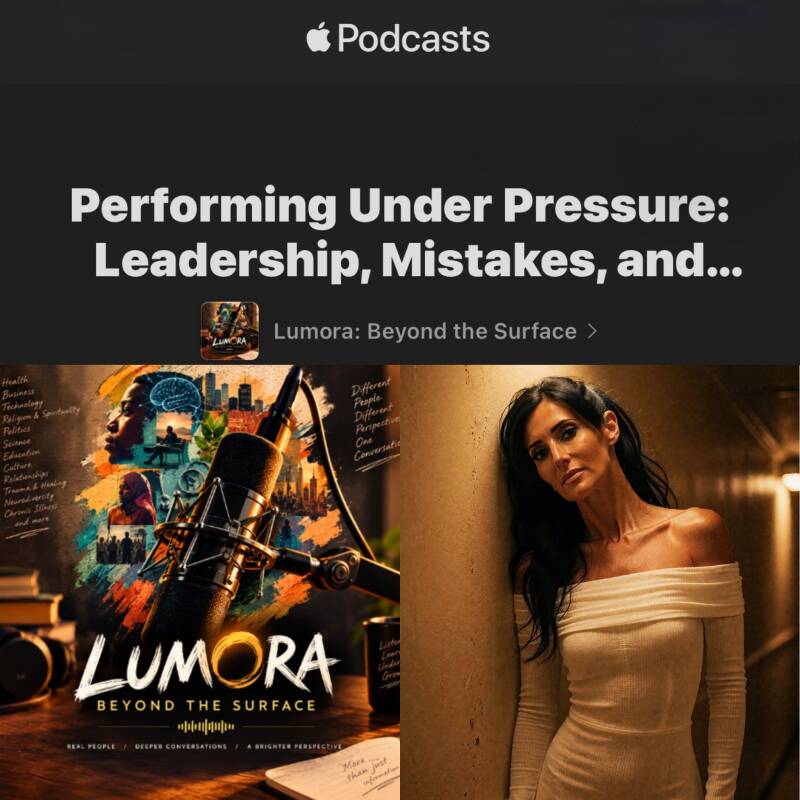
Podcast: Lumora: Beyond the Surface
Host: Okoro
About This Conversation
Experience is valuable. Preparation is essential. Confidence makes a difference.
But none of them guarantees that we will make the right decision when circumstances become difficult.
And that is precisely what makes high performance so fascinating.
In this episode of Lumora: Beyond the Surface, I joined Okoro for a conversation about leadership, decision-making, resilience, and the human factors that influence how we perform when expectations are high and outcomes are uncertain.
Drawing on my experience in international Grand Prix dressage, business, and coaching, we explored what happens when knowledge meets reality, when carefully prepared plans need to change, and when leaders must balance performance with responsibility.
Because achieving results is only one part of the equation.
How we reach them, how we respond when things go wrong, and how we treat ourselves and others along the way are equally important.
Topics We Discuss
- Experience and judgment: Why years of experience do not automatically guarantee better decisions under pressure.
- Leadership and accountability: The difference between taking responsibility and creating an environment of blame or humiliation.
- Mistakes and performance: How to analyse errors constructively without allowing them to define our abilities.
- Emotional management: Why understanding our own reactions matters when other people depend on our decisions.
- Resilience and adaptability: How to respond effectively when circumstances change unexpectedly.
- Excellence versus perfectionism: Why pursuing excellence encourages development, while demanding perfection can undermine performance.
- Identity and achievement: The importance of separating our personal worth from individual professional results.
- Lessons from elite sport: What demanding sporting environments can teach us about leadership, judgment, and everyday life.
My Thoughts
There is something I find particularly interesting about high performance.
People tend to focus on the visible result.
The victory. The successful decision. The achievement. The moment when everything comes together.
But a result tells us surprisingly little about the quality of the decisions that produced it.
A good decision can sometimes lead to an unsuccessful outcome.
And a poor decision can occasionally produce an excellent result.
That is why I believe we need to be careful about confusing success with competence.
In elite sport, this distinction becomes particularly clear.
You can prepare thoroughly, make intelligent decisions, and still encounter circumstances you cannot control.
Equally, you can make a questionable decision and get away with it.
The outcome alone does not tell the entire story.
Good judgment is not the ability to guarantee a result. It is the ability to make the most responsible decision with the information available.
Another important part of our conversation concerned accountability.
I believe in demanding standards. I believe in discipline, preparation, and responsibility.
But I do not believe that humiliating someone makes them better.
Accountability should help us understand what happened, what needs to change, and what we can learn.
When it becomes an exercise in blame, we risk losing the very information that could help us improve.
The same applies to perfectionism.
I have always maintained that perfection does not exist.
And in performance environments, presenting perfection as the objective is a fundamentally losing proposition.
Excellence is different.
Excellence requires ambition, attention to detail, constant development, and the intelligence to recognise when something needs to change.
It does not require us to be infallible.
We also explored something that deserves much more attention: the relationship between professional performance and personal identity.
A disappointing result is not a complete assessment of a person.
A victory does not make someone superior.
And one difficult moment should not have the authority to redefine everything we know about ourselves.
This matters enormously in leadership, because the way we evaluate ourselves often influences the way we evaluate others.
Ultimately, leadership is not simply about being capable of making decisions.
It is about understanding the consequences of those decisions, accepting responsibility, remaining adaptable, and recognising that behind every performance there are human beings.
Performance matters. But the quality of our judgment, our behaviour, and our responsibility matters just as much.
And that is what makes this conversation go beyond performance.
Lumora: Beyond the Surface — Available on Apple Podcasts.
Host Feedback ★★★★★
“Wonderful personality and insightful personality.”
A kind appreciation from the Lumora team following our conversation.
Add comment
Comments