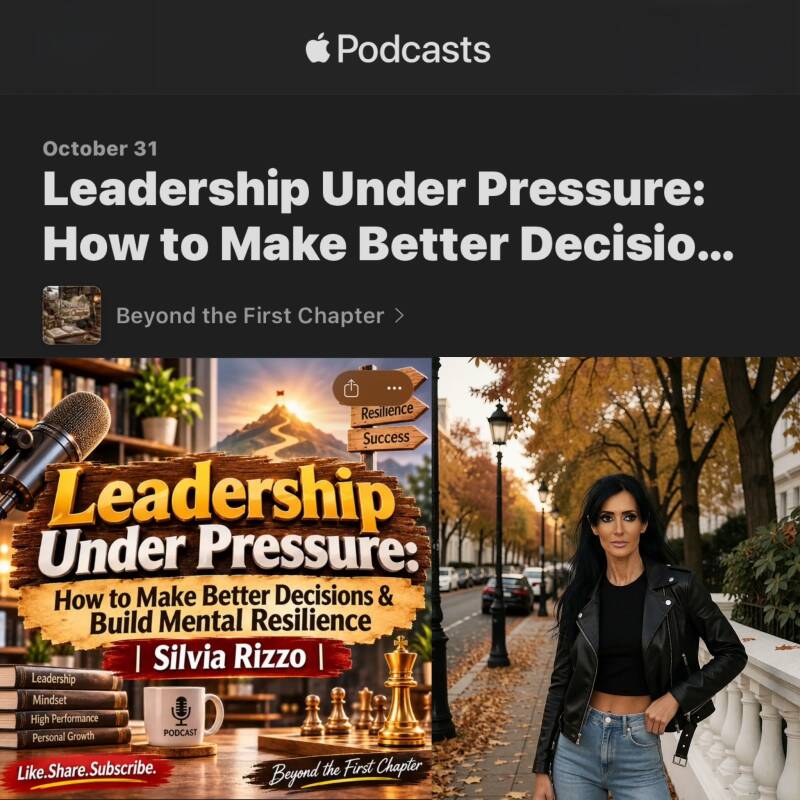
Podcast: Beyond the First Chapter
About This Conversation
There is a question I find particularly interesting.
How much do we really need to know before we are ready to make a decision?
We live in a world that encourages us to gather information, analyse possibilities, minimise risks, and prepare for every conceivable outcome.
All reasonable things to do.
Until preparation becomes an excuse for postponing action.
In this episode of Beyond the First Chapter, we explore leadership, mental resilience, decision-making, and the uncomfortable reality of acting without knowing exactly what will happen next.
Because in sport, business, and life, certainty is rarely available when we need it most.
The Dangerous Comfort of Waiting
Waiting can feel intelligent.
We tell ourselves that another conversation, another opinion, or another piece of information will make the decision easier.
Sometimes it does.
But sometimes we are simply looking for a guarantee that nobody can give us.
And the longer we wait, the more we risk confusing hesitation with responsibility.
I have made important decisions throughout my sporting career without knowing whether they would lead to the result I wanted.
That is not recklessness.
It is recognising that every decision has a moment when thinking must become action.
The absence of certainty does not automatically justify the absence of a decision.
Confidence Is Not the Same as Certainty
People often associate confidence with knowing exactly what they are doing.
I see it differently.
Confidence does not mean believing that everything will work.
It means accepting that things might not work and still being capable of responding.
There is a considerable difference.
A confident person can question a decision, recognise an error, and change direction.
Someone who depends on always appearing certain may find those same actions threatening.
And that is where confidence can become a performance rather than a genuine ability.
Mental Resilience Is Not About Feeling Strong
Resilience is frequently presented as an emotional quality.
Being positive. Feeling motivated. Believing in yourself.
But emotions change.
And I have never considered temporary motivation a reliable foundation for long-term performance.
What matters is what remains when enthusiasm disappears.
Your habits.
Your discipline.
Your ability to evaluate circumstances without allowing every emotional reaction to determine your next move.
Mental resilience is not the absence of difficult moments.
It is the ability to continue functioning intelligently through them.
What We Discussed
- Making decisions when information is incomplete.
- The difference between confidence and certainty.
- Why waiting can become a hidden form of avoidance.
- Mental resilience in high-performance environments.
- Managing mistakes without sacrificing credibility.
- How experience influences judgment.
- The balance between adaptability and personal responsibility.
- Why motivation alone cannot sustain performance.
My Thoughts
I have never believed that the right decision is necessarily the one that produces the result we wanted.
We can make an intelligent decision and still experience an unfavourable outcome.
We can also make a poor decision and get lucky.
That is why I think judging the quality of a decision exclusively by its result is a mistake.
What interests me is the process.
What did we know?
What could we reasonably evaluate?
What responsibility were we prepared to accept?
And, perhaps most importantly, what did we do when reality gave us an answer we had not anticipated?
Because the ability to decide is not proven by always being right. It is proven by remaining responsible even when we are wrong.
Listen to the Episode
Available on Apple Podcasts.
Continue Reading
Success can reinforce our confidence, but it doesn’t always confirm that our decisions were correct. Sometimes, the lessons we take from winning deserve just as much scrutiny as those we learn from failure.
Explore this perspective further in When Success Teaches the Wrong Lesson, on Hof Marabunta Blog.
Add comment
Comments